How Playing Outside Can Help Reduce the Negative Effects of Screen Time
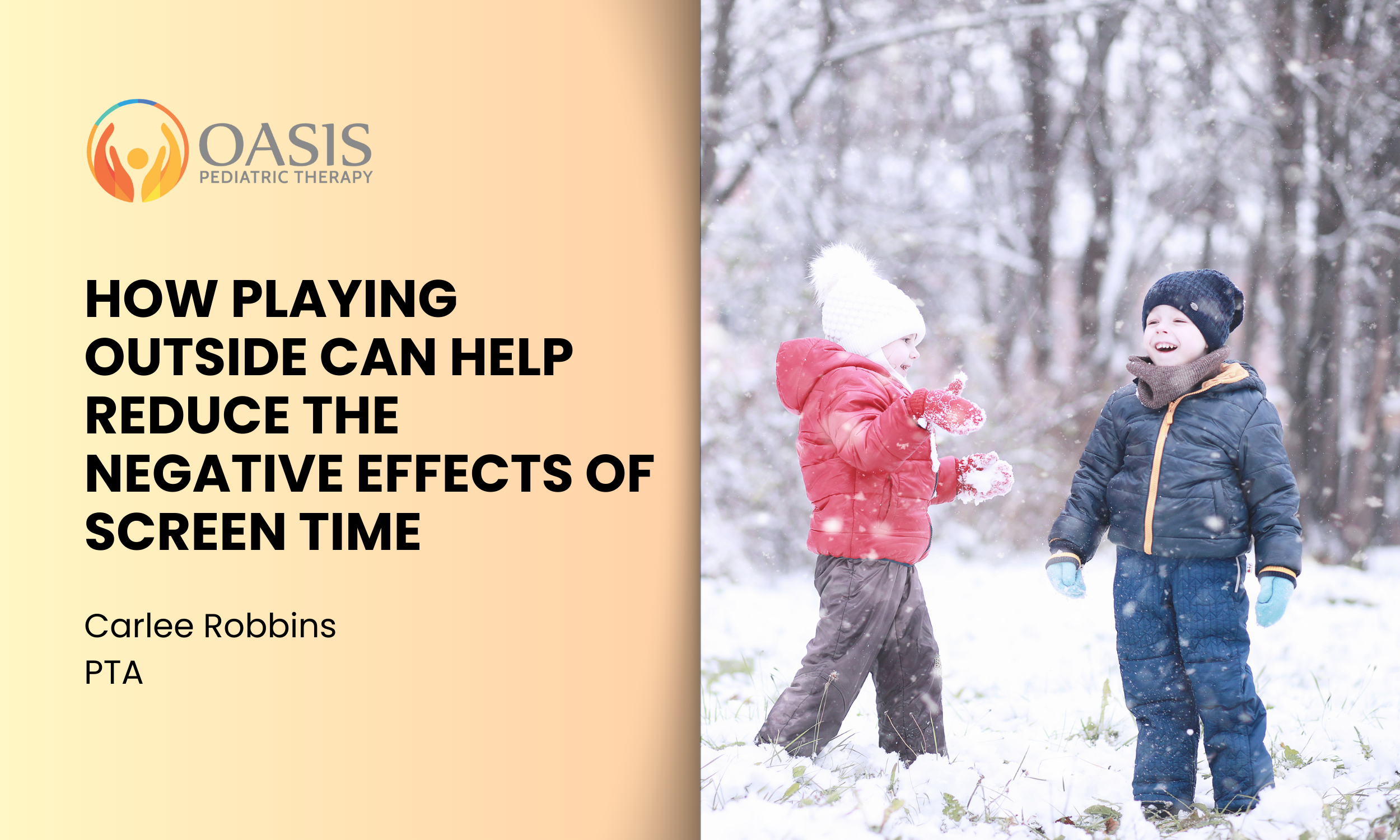
At OASIS Pediatric Therapy, we believe that children learn best through movement, play, and meaningful connection with the world around them. In today’s digital age, screens are everywhere—phones, tablets, televisions, and computers have become a regular part of family life. While technology can be useful and even educational in moderation, increasing research shows that excessive screen time during early childhood may negatively impact a child’s development. The good news? One powerful and accessible tool can help balance these effects: outdoor play.
This article explores how playing outside can help offset some of the challenges associated with screen time and why prioritizing outdoor experiences is so important for young children’s overall development.
Understanding Screen Time and Early Development
Screen time refers to the amount of time a child spends engaging with digital media. For young children, especially those under the age of five, high levels of screen exposure have been linked to delays in communication, social interaction, attention, and daily living skills. When screens take the place of hands-on play, peer interaction, and movement-based learning, children may miss critical opportunities to build foundational skills.
That said, screens are not inherently “bad.” The concern arises when screen use becomes excessive or replaces experiences that are essential for healthy brain and body development. This is where outdoor play becomes especially important.
How Outdoor Play Supports Development
Outdoor play offers rich, multi-sensory experiences that simply cannot be replicated on a screen. When children play outside, they are moving their bodies, problem-solving in real time, interacting with peers, and engaging all of their senses. These experiences support development across multiple areas.
1. Communication and Language Skills
Outdoor play naturally encourages communication. Whether children are pretending, negotiating the rules of a game, or describing what they see around them, they are practicing expressive and receptive language skills. Unlike screen-based activities, outdoor play is interactive and responsive, requiring children to listen, respond, and adapt their communication in real time.
For toddlers and preschoolers, this type of language-rich environment is especially valuable. Research suggests that children who spend more time playing outdoors demonstrate stronger communication skills, even when they also have higher levels of screen exposure.
2. Social and Emotional Development
Playing outside often involves other children, which creates opportunities to practice social skills such as sharing, taking turns, cooperating, and managing emotions. Children learn how to navigate disagreements, read social cues, and express their feelings appropriately.
Studies have shown that higher screen time is associated with lower social skill scores, while increased outdoor play is linked to stronger social-emotional abilities. Time spent outdoors helps children build confidence, resilience, and empathy—skills that are essential for long-term success.
3. Daily Living and Independence Skills
One particularly interesting finding from recent research is the relationship between outdoor play and daily living skills. A large study of preschool-aged children found that frequent outdoor play around age two-and-a-half helped reduce the negative impact of screen time on later independence skills. These skills include things like following routines, dressing oneself, and participating in age-appropriate self-care tasks.
In other words, children who spent more time playing outside showed stronger independence later on, even if their screen time was relatively high. Outdoor play encourages problem-solving, persistence, and physical coordination—all of which contribute to a child’s ability to manage daily tasks more independently.
4. Physical and Sensory Development
Outdoor environments provide natural opportunities for climbing, running, jumping, balancing, and exploring uneven surfaces. These activities support gross motor development, strength, coordination, and body awareness. Additionally, outdoor play offers valuable sensory input through textures, sounds, sights, and movement, helping children regulate their nervous systems and improve attention.
At OASIS Pediatric Therapy, we often see how movement and sensory-rich experiences can improve a child’s ability to focus, engage, and participate in both play and daily routines.
Outdoor Play as a Protective Factor
While reducing screen time is important, research suggests that increasing outdoor play can act as a protective factor when screen use is present. Rather than focusing solely on eliminating screens, families can benefit from creating a healthy balance—one that emphasizes active, real-world experiences.
Outdoor play helps “fill in the gaps” by providing the interaction, movement, and engagement that screens lack. It encourages children to be curious, creative, and socially connected, which supports more well-rounded development.
Recommendations for Families
The American Academy of Pediatrics recommends limiting screen time to no more than one hour per day for children ages 2 to 5, focusing on high-quality content and co-viewing when possible. They also emphasize the importance of prioritizing physical activity, outdoor play, and face-to-face interactions.
Here are a few practical ways families can incorporate more outdoor play into daily routines:
Schedule regular outdoor time each day, even if it’s just 20–30 minutes
Encourage unstructured play, allowing children to explore and lead
Participate as a family—walks, bike rides, or backyard games count
Create a family media plan that balances screen use with active play
Use outdoor play as a transition away from screens
Our Philosophy at OASIS Pediatric Therapy
At OASIS Pediatric Therapy, we take a play-based, family-centered approach to supporting children’s development. We recognize that every family’s situation is different, and our goal is not perfection—but balance. By encouraging outdoor play and meaningful interaction, we help families support their child’s communication, social, motor, and daily living skills in a natural and enjoyable way.
If you have concerns about your child’s development, screen use, or play skills, our interdisciplinary team of physical, occupational, and speech therapists is here to help. Together, we can create strategies that support your child’s growth—one playful step at a time.
Research summarized from peer-reviewed pediatric literature on screen time, outdoor play, and early childhood development.